Contribuer au contenu ou vous faire connaître à l’Afrique et sa diaspora ? Contactez-nous ! Want to contribute content or promote yourself to Africa and its diaspora? Contact us!
Uganda Fish Farming Drive Triumphs Over Wetland Degradation

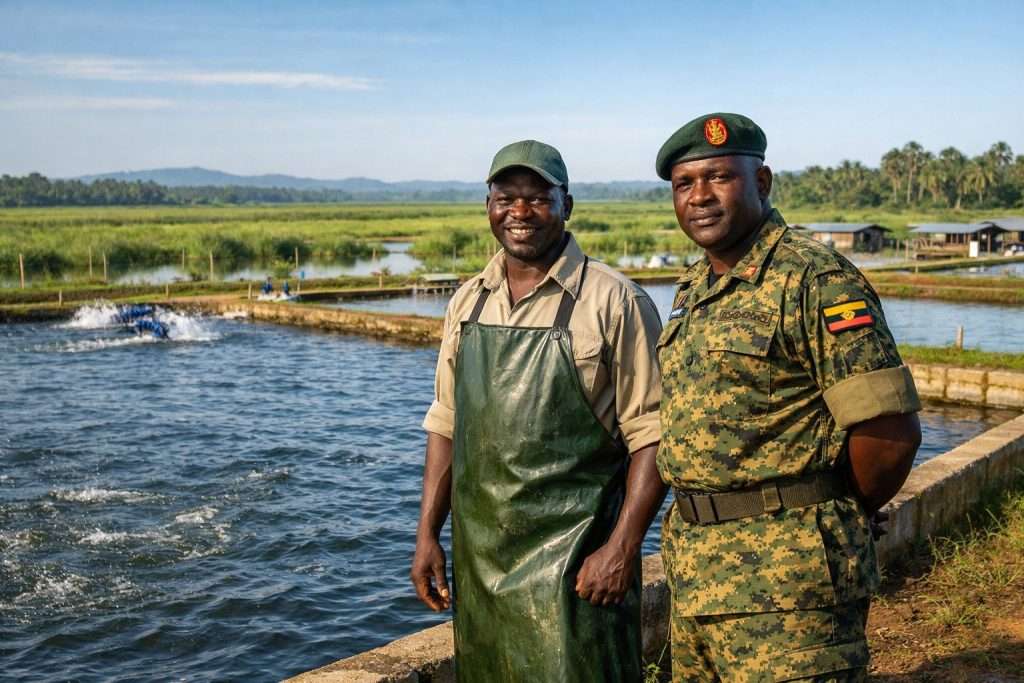
A major agricultural shift is underway in Eastern Uganda as a strategic government initiative successfully transitions local farmers from traditional rice cultivation to commercial aquaculture. The ecological drive aims to restore degraded wetlands while unlocking massive economic returns for grassroots communities.
The Limits of Rice vs. The Power of Aquaculture
For decades, wetland ecosystems across Pallisa and surrounding districts have faced severe environmental pressure from continuous rice farming. Beyond the ecological toll, traditional rice cultivation offers minimal financial security, with farmers netting roughly 200,000 Ugandan shillings per acre over a six-month cycle.
In stark contrast, the newly established Limoto Fish Farm is demonstrating the staggering profitability of aquaculture. Managed with oversight from the Uganda People’s Defence Forces (UPDF) under Major David Muwanga Kibirango, the model farm has scaled rapidly to 26 operational fishponds.
According to comparative data, a single acre can easily accommodate four fishponds. While the initial five-month investment requires approximately 15 million shillings for feed and 5 million shillings for labor, the financial payoff is immense. A single pond can yield at least 10,000 fish, generating up to 70 million shillings at harvest. Across a full acre, this pushes potential earnings to 280 million shillings—completely eclipsing traditional rice revenues.
Expanding the Footprint to Kaitambiri
Following the visible success at Limoto, State House expanded the initiative to the Kaitambiri Fish Farm project to accommodate high demand from local farmers. Developed through a joint partnership between State House and the Ministries of Water, Environment, and Agriculture, Kaitambiri has already established six fully stocked ponds.
Local farming leaders have hailed the project as a critical turning point for household incomes, noting that it offers a sustainable alternative to the low-yield, environmentally damaging practices of the past.
Solving the Supply Chain Challenge
During a recent progress assessment, State House Comptroller Ms. Jane Barekye addressed core challenges raised by farmers, including security, high feed costs, and market access.
To secure the value chain, State House officially partnered with Masheda Holdings Company Limited to provide a guaranteed market for the harvests. The company committed to purchasing catfish at 7,000 shillings per kilogram and tilapia at 7,500 shillings per kilogram. Furthermore, plans were unveiled to construct a local fish feed factory to drastically lower production expenses for farmers.
With over one billion shillings already invested by President Museveni into the infrastructure, the government is now focused on sustainability. State House has committed to installing perimeter fencing to combat theft and ensure the long-term security of this transformative economic engine.