Contribuer au contenu ou vous faire connaître à l’Afrique et sa diaspora ? Contactez-nous ! Want to contribute content or promote yourself to Africa and its diaspora? Contact us!
Tagine : The Stew That Steams Itself

D – Describe the Dish
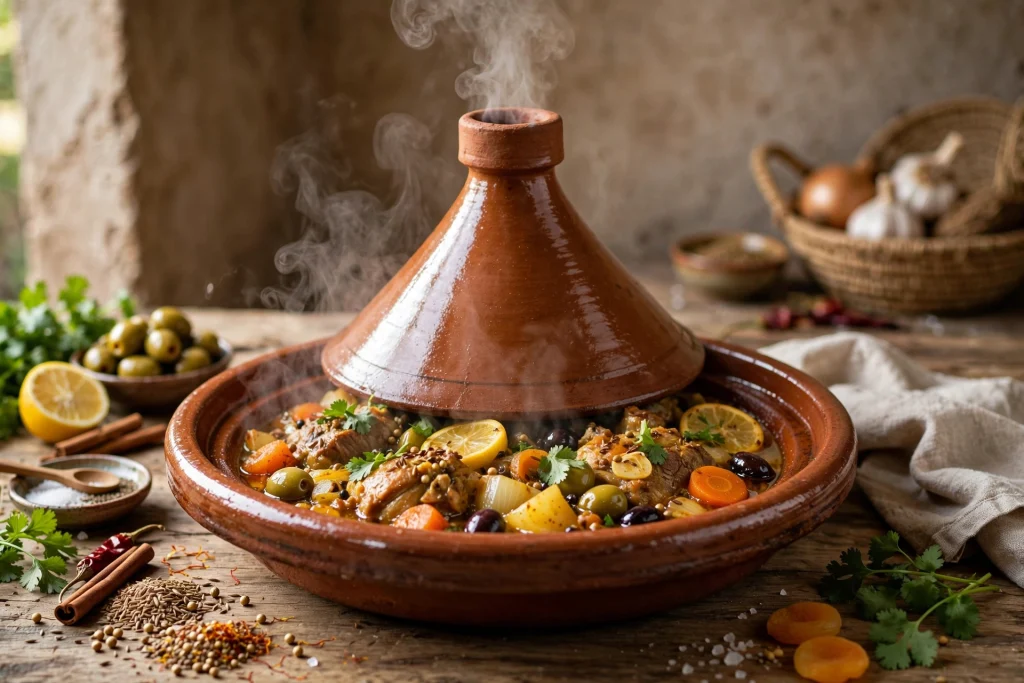
Imagine lifting the conical lid of a beautifully decorated clay pot. A cloud of fragrant steam billows out, carrying the warm, intoxicating aroma of cumin, cinnamon, saffron, and preserved lemon. Inside, you see glistening, fall-off-the-bone lamb or chicken nestled among soft, caramelized onions, briny green olives, and golden wedges of preserved lemon. The sauce is rich, silky, and deeply savory—with a bright, tangy citrus note that cuts through the richness of the meat.
You tear off a piece of crusty bread, dip it into the sauce, and scoop up a tender morsel of lamb. The meat melts in your mouth, infused with the complex sweetness of dried apricots or the earthy depth of olives. Each bite is a journey through layers of flavor—sweet, salty, sour, and spicy all at once.
This is Tagine. It is not just a stew. It is a cooking method, a vessel, and a cultural icon all rolled into one. It is the dish that defines North African hospitality, slow-cooked over gentle coals for hours, allowing the ingredients to meld into something far greater than the sum of their parts.
I – Identity & Origin
The Tagine takes its name from the earthenware pot in which it is cooked—a wide, shallow base with a tall, cone-shaped lid. This design is genius: as the stew simmers, steam rises, condenses against the cool interior of the cone, and trickles back down into the base, continuously basting the meat with its own juices. This self-basting mechanism allows the dish to cook with very little water, resulting in intensely concentrated flavors.
The origins of the Tagine trace back to the Berber people of North Africa (the indigenous Amazigh population) who have lived in the Maghreb region—modern-day Morocco, Algeria, Tunisia, and Libya—for thousands of years. The Berbers were nomadic herders and farmers who used tagines as portable ovens; the heavy clay pots could withstand high heat and were easy to transport.
When the Arabs arrived in the 7th century, they brought with them a sophisticated arsenal of spices—cinnamon, ginger, turmeric, saffron, and dried fruits like dates and apricots from the Middle East. The fusion of Berber simplicity and Arab sophistication gave birth to the modern Tagine as we know it today.
In the 15th century, when the Spanish and Portuguese expelled Jews and Muslims during the Inquisition, many Sephardic Jews fled to Morocco. They brought with them the technique of preserving lemons in salt and lemon juice—a method that became a cornerstone of Moroccan Tagine cuisine.
Today, the Tagine is more than a dish—it is a symbol of Moroccan and North African identity, often served at weddings, festive gatherings, and Friday lunches after prayers. It represents patience, generosity, and the art of sharing.
Countries where it is a staple: Morocco, Algeria, Tunisia, Libya, and parts of Mauritania.
S – Secrets of the Ingredients
The magic of Tagine lies in the balance of a few key ingredients:
- The Meat: Lamb is the most traditional choice (particularly shoulder or neck, which are tough and benefit from slow cooking), but chicken, beef, goat, and even fish (especially in coastal Algeria and Tunisia) are common. The bone-in cuts are preferred—the marrow releases gelatin, which thickens and enriches the sauce.
- The Preserved Lemon (L’hamd Markad): This is the signature ingredient of Moroccan Tagines. Preserved lemons are quartered, heavily salted, and packed in a jar with lemon juice and spices for at least a month. The fermentation process transforms the lemon rind into a soft, intensely citrusy, savory-clean flavor that is unlike anything else. It cannot be substituted with fresh lemon juice—the result will be sour and thin, not complex and fermented.
- The Spice Blend (Ras el Hanout): Literally translating to “head of the shop,” this is the spice merchant’s finest blend. It typically contains up to 30 ingredients, including cumin, coriander, turmeric, cinnamon, ginger, cardamom, nutmeg, cloves, and sometimes chili or even rose petals. Each merchant has their own secret recipe. You can buy a pre-made blend or make a simplified version.
- The Sweet vs. Savory Balance: Tagines fall into two distinct flavor camps:
- Savory-Salty: Featuring preserved lemons, olives, and herbs (like chicken or lamb tagine with olives).
- Sweet-Savory: Featuring dried fruits—apricots, dates, figs, or prunes—and often drizzled with a little honey or sprinkled with toasted almonds (like lamb tagine with prunes).
- The Onions: Onions are almost always caramelized slowly in the Tagine, providing a natural sweetness and body to the sauce.
- The Tagine Pot (If You Have One): While you can use a Dutch oven or heavy-bottomed pot, a traditional clay or ceramic Tagine pot is worth it if you can find one. The clay imparts a subtle, earthy flavor and allows for the most even, gentle heat. Never put a clay tagine on high heat—it will crack. Always use a heat diffuser or start it on low, increasing the temperature gradually.
H – How to Eat It
Tagine is a dish designed for communal, unhurried enjoyment:
- The Presentation: The Tagine pot is brought directly to the table—never plated in the kitchen. The lid is lifted in front of the guests, allowing everyone to witness the dramatic reveal of steam and aroma. This is a moment of theater and anticipation.
- The Bread: You eat Tagine without a fork or spoon. Instead, you use crusty Moroccan khobz bread (a round, slightly chewy flatbread) to scoop up the sauce, meat, and vegetables. The bread is torn into pieces with your right hand and used as an edible utensil. (Many modern Moroccans will use a spoon, but traditionalists insist on bread).
- The Etiquette:
- Break off a piece of bread, fold it into a small scoop, and use it to capture a piece of meat and some sauce. Do not bite directly from the shared bread loaf—tear off your own portion.
- Do not double-dip your bread into the communal sauce bowl.
- The most prized pieces are the preserved lemon rind and the caramelized onions at the bottom—these are usually offered to the guest of honor.
- The Pace: Tagine is eaten slowly. It’s not fast food. It’s a social event, where conversation and long, drawn-out bites are part of the ritual.
E – Exact Recipe (Moroccan Lamb Tagine with Prunes & Almonds)
(Serves 4-6 | Active time: 25 mins | Cooking time: 2.5 – 3 hours)
IMPORTANT NOTE: This recipe produces a sweet-savory tagine with prunes—a favorite for festive occasions. If you prefer a savory-saltier tagine, swap the prunes for green olives and add an extra preserved lemon.
Ingredients for the Tagine:
- 1.5 kg (3.3 lbs) lamb shoulder or neck, cut into large chunks (bone-in, if possible)
- 2 large onions, finely chopped
- 4 cloves garlic, minced
- 2 tablespoons Ras el Hanout spice blend (store-bought or homemade—see recipe below)
- 1 teaspoon ground ginger
- ½ teaspoon turmeric
- ½ teaspoon black pepper
- 1 pinch saffron threads (steeped in 2 tablespoons warm water)
- 1 preserved lemon, quartered, seeds removed, and chopped (rind only)
- 2 cups water or lamb stock
- 2 tablespoons olive oil
- Salt to taste
- 1 cup dried prunes (pitted)
- 2 tablespoons honey
- ½ cup toasted almonds (slivered or whole)
- Fresh coriander or parsley, for garnish
Step-by-Step:
- Season the meat: In a large bowl, combine the lamb chunks with the chopped onion, garlic, Ras el Hanout, ginger, turmeric, pepper, and olive oil. Massage the spices into the meat, cover, and marinate for at least 2 hours (or overnight in the fridge for best results).
- Sear (if using a Dutch oven): If you’re using a heavy-bottomed pot, heat it over medium-high heat. Add the marinated lamb and sear on all sides until browned (about 5-7 minutes). If you’re using a clay Tagine, skip the searing (you cannot sear in clay) and proceed directly to step 3.
- Start the stew: Add the 2 cups of water or stock, the saffron (with its soaking water), and half of the chopped preserved lemon. Bring to a gentle simmer. If using a Tagine pot, place it on a heat diffuser over very low heat.
- Slow cook: Cover the pot (or place the cone lid on the Tagine) and cook on the lowest possible heat for 2 hours. Do not stir more than once or twice during this time. The slow, gentle heat will break down the collagen in the lamb, making it fork-tender.
- Soak the prunes: While the lamb is cooking, soak the prunes in a separate bowl with warm water for 15 minutes. Drain.
- Add the prunes and honey: After 2 hours, check the lamb—it should be nearly falling apart. Gently stir in the soaked prunes and the honey. Cover and cook for another 30 minutes, until the prunes are plump and the sauce has thickened and become glossy.
- Finish: Stir in the remaining preserved lemon rind. Taste and adjust salt. The sauce should be syrupy and rich, with the sweetness of the honey balanced by the tangy, fermented lemon.
- Garnish: Toast the almonds in a dry pan until golden. Just before serving, scatter the toasted almonds and fresh coriander over the top.
Serve directly from the Tagine pot, with plenty of crusty bread for dipping.
Bonus: Simplified Ras el Hanout (Homemade Blend)
(Mix in a small jar and store in a dark cupboard)
- 1 tablespoon ground cumin
- 1 tablespoon ground coriander
- 1 tablespoon ground ginger
- 1 tablespoon ground turmeric
- 2 teaspoons ground cinnamon
- 2 teaspoons ground cardamom
- 2 teaspoons ground black pepper
- 1 teaspoon ground nutmeg
- 1 teaspoon ground allspice
- 1 teaspoon ground cloves
(Optional: ½ teaspoon cayenne pepper for a subtle heat)
Bonus: Quick Preserved Lemons (2-Week Method)
(Make these ahead of time—they last for a year)
- 4–5 organic unwaxed lemons
- ½ cup coarse sea salt
- ¼ cup fresh lemon juice (from extra lemons)
Method: Quarter the lemons but keep them attached at the base. Stuff the cut sections with salt. Place them tightly into a sterilized glass jar, pressing them down so they release their juices. Add the extra lemon juice to cover. Seal and leave at room temperature for 2 weeks, shaking daily. After that, they are ready to use—only the rind is used in cooking; discard the flesh or use it in dressings.
S – Save-Our-Steak Tips (Common Mistakes)
- Mistake #1 – High Heat (Killer of Tagines): Tagine is a low-and-slow dish. If you use high heat, you’ll burn the bottom, scorch the spices, and the meat will be tough. On a stovetop, use the smallest burner on the lowest possible heat. If using an oven, cook at 160°C (320°F).
- Mistake #2 – Too Much Liquid: The Tagine’s conical lid is designed to create condensation. You only need enough liquid to cover the base of the pot by about 1 cm (½ inch). Adding too much water will result in a watery stew, not a rich, concentrated sauce. Trust the self-basting design.
- Mistake #3 – Using Fresh Lemon Instead of Preserved: This is the most common error. Fresh lemon juice will make the sauce sour and bitter. Preserved lemons have a mellow, fermented, almost floral flavor. You can buy them online or in Middle Eastern grocery stores. If you absolutely cannot find them, substitute with equal parts lemon zest and a splash of white wine vinegar—but know it’s not the same.
- Mistake #4 – Skipping the Marination: The spices need time to penetrate the meat. Marinating for at least 2 hours (or overnight) is not optional—it’s the difference between a tagine that tastes like spice rub and a tagine that tastes like a unified, complex dish.
- Mistake #5 – Not Adding Salt Early Enough: The preserved lemon is salty, so some cooks delay salting the meat. But the lamb needs early salting (combined with the spices) to draw out its juices and develop flavor. Add salt to the marinade, and taste for extra salt only at the very end after the preserved lemon has released its saltiness.
- Pro Hack: If your Tagine sauce is too thin after cooking, remove the meat, turn up the heat, and boil the sauce uncovered for 5-10 minutes to reduce and thicken. If it’s too thick, stir in a splash of hot water until it loosens.