Contribuer au contenu ou vous faire connaître à l’Afrique et sa diaspora ? Contactez-nous ! Want to contribute content or promote yourself to Africa and its diaspora? Contact us!
The 46th SADC Ordinary Summit: Charting a Path Toward Resilient, Inclusive Industrialisation

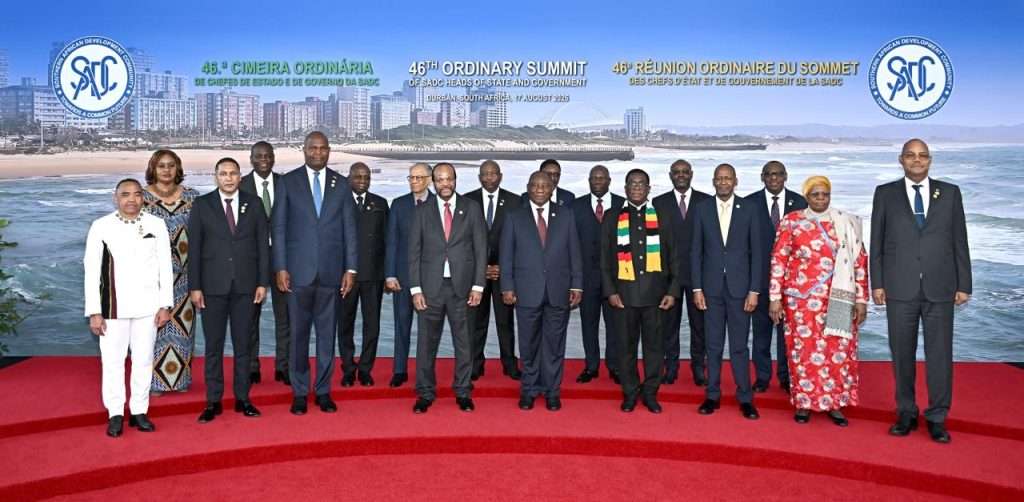
On 17 August 2026, leaders of the Southern African Development Community gathered in Durban, South Africa, for the 46th Ordinary Summit of Heads of State and Government. Hosted and chaired by South African President Cyril Ramaphosa at the Durban International Conference Centre, the meeting marked a pivotal moment for regional cooperation under a clear and ambitious theme: “Resilient, Sustainable, and Inclusive Industrialisation through Infrastructure Development, Agricultural and Critical Minerals Transformation in Pursuit of a Just World.”
The summit came against a backdrop of both continuity and transition. South Africa had served as interim chair following political developments in Madagascar that led that country to relinquish the role earlier. Zimbabwe’s President Emmerson Mnangagwa, as outgoing chair, formally handed over leadership. The summit elected Ramaphosa as SADC Chairperson and designated the President of Zambia as Incoming Chairperson. King Mswati III of Eswatini was elected Chairperson of the Organ on Politics, Defence and Security Cooperation. The next ordinary summit is scheduled for Zambia.
A Focused Agenda on Integration and Development
Leaders reviewed progress under the Regional Indicative Strategic Development Plan (RISDP) 2020–2030 and Vision 2050. Discussions centred on accelerating industrialisation by leveraging the region’s strengths in infrastructure, agriculture, and critical minerals. The theme builds on the previous year’s emphasis on industrialisation, agricultural transformation, and energy transition, with a sharpened focus on turning natural endowments into jobs, value chains, and shared prosperity.
Key priorities highlighted include:
- Developing and operationalising regional economic corridors to connect production centres to markets and link landlocked countries to ports.
- Accelerating One-Stop Border Posts to cut delays and lower the cost of cross-border trade.
- Strengthening energy cooperation, expanding generation and transmission, and improving access to reliable, affordable power (with a regional target of at least 85% electricity access by 2030).
- Operationalising the SADC Regional Development Fund to mobilise domestic and external resources for infrastructure and industrial projects without compromising sovereignty.
- Advancing agricultural trade by removing non-tariff barriers, harmonising standards, and preparing for climate shocks such as El Niño through early warning systems and climate-smart practices.
- Beneficiating critical minerals and building competitive regional value chains.
The summit approved the Agreement Establishing the SADC Tourism UNIVISA to facilitate seamless regional travel and boost tourism. It also urged member states to ratify outstanding legal instruments and accelerate signature and ratification processes.
Peace, Security, and Political Stability
Security remained high on the agenda. Leaders reaffirmed solidarity with the Democratic Republic of Congo amid ongoing challenges in the east, including an Ebola (Bundibugyo) outbreak, and called for coordinated regional and international responses to protect civilians, strengthen humanitarian efforts, and promote inclusive dialogue. They welcomed Mozambique’s inclusive national dialogue and continued efforts against terrorism in Cabo Delgado, while congratulating President Daniel Chapo on inaugurating the SADC Regional Fisheries Monitoring, Control and Surveillance Coordination Centre.
On Madagascar, the summit welcomed constructive engagement through the SADC Panel of Elders (supported by the Mediation Reference Group and Secretariat) and reaffirmed support for the reform process aimed at inclusive governance, democratic institutions, accountability, human rights, and a return to constitutional normalcy. Stakeholders were urged to maintain calm and pursue dialogue. The summit also appointed former Botswana President Mokgweetsi Masisi and former Mozambique President Joaquim Chissano to the Panel of Elders.
Additional notes included congratulations to Zimbabwe on its election as a non-permanent member of the UN Security Council for 2027–2028 and a renewed call for the removal of sanctions on the country. South Africa briefed leaders on migration governance, prompting a call for coordinated regional dialogue on the drivers of migration and sustainable responses. Progress on gender equality and youth mainstreaming was also encouraged.
Implementation as the Defining Challenge
In his closing statement, President Ramaphosa emphasised that the prosperity, security, and development of individual countries are inseparable from those of the region as a whole. He stressed that industrialisation is a means to create jobs, expand productive capacity, beneficiate minerals, strengthen agro-processing, and build competitive value chains. South Africa intends to place infrastructure—especially corridors, railways, ports, roads, energy interconnection, and water/sanitation—at the centre of its chairship.
“The challenge before us is therefore implementation,” he said. Progress will be measured not only by meetings and agreements, but by kilometres of railway rehabilitated, megawatts of electricity generated and transmitted, border-crossing times reduced, factories established, intra-regional trade expanded, and jobs created.
The summit also noted the successful 9th Annual SADC Industrialisation Week held in Durban in late July and a public lecture by Ramaphosa at the University of KwaZulu-Natal on translating Vision 2050 into action.
Looking Ahead
The 46th Summit reaffirmed SADC’s political will for deeper integration while underscoring the need to move decisively from resolutions to results. With abundant resources, a young population, growing markets, and existing institutions, Southern Africa has the ingredients for transformative growth. The test of the coming year under South Africa’s chairship—and beyond—will be whether that potential is converted into tangible improvements in the daily lives of the region’s citizens.
As leaders departed Durban, the message was clear: borders should connect rather than divide, resources should be transformed into prosperity, and the benefits of regional integration must reach all the people of Southern Africa.